I am a crime writer, mostly 'cozy' crime but also some psychological thrillers. There are two sets - Cleo Marjoribanks Mysteries (set mostly in the New Forest) and The South Downs Murder Mysteries. There are also some stand alone novels. They are all on Kindle - if you don't have one, get the Kindle APP! I am also an international travel writer so some of my blogs are about my travel. I hope you buy lots of my books, enjoy them and enjoy my blogs.
Thursday, 17 February 2011
George Pullman, American Entrepreneur and Creator of the Pullman Car
In the 19th century Pullman improved rail travel with comfortable railroad cars. He started with sleepers and expanded from there. He was also involved in other projects.
Nowadays the most famous Pullman cars are those that make up the Orient Express with its cream and brown livery. Although these carriages were built in the 20th century, they were invented in the mid-19th century.
George Mortimer Pullman - the Early Years
George was born in 1831 in Brockton, New York. His father was a farmer and his mother’s uncle owned a general store. After 4th grade George left school and went to work in the store.
In 1845 his father, Lewis, gave up farming and moved to Albion, NY, where he worked as a carpenter on the Erie Canal.
A few years later George joined his parents, as did two of his brothers.
Lewis invented a method of moving buildings and, when he died, George took over his place in the family cabinet making business. In 1854 he contracted with New York State to move about 20 buildings away from the canal.
In 1857 he helped raise buildings in Chicago so that a sewer system could be installed to control the annual flooding.
The First Sleeping Cars
There are an overnight train from Buffalo to Westfield, NY, but it was very uncomfortable and Pullman saw the potential for a more comfortable sleeping car.
In 1857 he formed a partnership with one of his friends, Benjamin C. Field, to build and operate these cars. They received a contract from the Chicago, Alton & St. Louis Railroad.
To being with they converted two cars, Pullman drawing on his experience of sleeping accommodation on the canal boats.
Field, who had been a New York State Senator, was more interested in politics so left the partnership.
The 1859 Colorado Gold Rush
George Pullman found another way to make money. Not by panning for gold but by providing (with James E. Lyon) a freight business and an ore crushing mill.
The partnership didn’t last long and shortly thereafter, along with Spafford C. Field (Benjamin’s brother), Pullman acquired acreage for Cold Spring Ranch. This became a base camp for the miners.
Back to Chicago and the Pullman Cars
In 1863 Springfield and Pioneer were built. They were expensive but they were clean, comfortable and beautiful. Each cost $18,000.
Following the assassination of Abraham Lincoln, the President’s body was taken to his home in Springfield, Illinois, in a Pullman.
The publicity engendered piqued Andrew Carnegie’s interest and he became a major investor in the Pullman Company.
In 1867 Pullman created his first sleeper with attached kitchen and dining car and named it the President. The following year Delmonico joined the fleet, offering fine cuisine.
In 1869 Pullman consolidated his manufacturing operations in Chicago. The company produced five classes of carriages: hotel, parlor, reclining room, sleepers and diners.
Marriage, Family and Homes
George’s wife was Harriet (nee Sanger) whom he married in 1867. They had four children: Florence, Harriet, George Jr and Walter Sanger - the latter pair being twins.
Ten years later George had a house built on S. Prairie Ave, Chicago. It was demolished in 1922 under the provisions of Mrs. Pullman’s Will.
In 1888 George had another house built. This was on Pullman Island in Alexandria Bay. He also had homes in Albion, NY and Long Branch, NJ.
The Final Years
In 1880 Pullman purchased 4,000 acres near Lake Calumet (about 14 miles south of Chicago). Here he built his plant and adjacent town and called it Pullman.
Following employee unrest and a strike in 1894, the Illinois Supreme Court made the Pullman Company divest its ownership of the town. This was in 1898.
George Pullman didn’t live to hear of this ruling. He suffered a heart attack and died in 1897. He was 66 and was buried at the Graceland Cemetery.
The Bluebell Railway in Sussex uses Pullman coaches for special events. (www.bluebell-railway.co.uk)
References: Pullman-museum.org
Pullman-car.com
Monday, 7 February 2011
Single Room Supplements
Many years ago I campaigned against single room supplements and here I go again.
Why? Because we single travellers are still being discriminated against.
In European hotels we are given rooms not much bigger than broom cupboards, no balcony and, if we are lucky, a shower (no bath). I have even ended up in rooms with h&c. And for this privilege we are charged extra.
Doesn’t make sense, does it, especially as the hotels only charge the tour operators half price (or thereabouts) for those rooms. But it does make sense when you look through the brochures and see how many operators offer family holidays with ‘free’ child places. Who is paying for their flights?
Single people.
As one friend said to me, “I am single, I don’t have children, I don’t even like children, so why should I pay for their holidays?”
In America there is one small consolation – you get a full sized room. BUT, you only use one bed and one person’s set of towels and only make one person’s mess. Ergo the hotel is saving on linens, laundry and maid time.
For single people there is one type of holiday that is fantastic as you get to meet people very quickly – cruising. Unfortunately, you are also expected to pay for two people. Why? You only use one bed and one person’s set of towels, added to which, you only eat one person’s FOOD.
Recently while researching for this article I discovered that there are singles holidays either by specialist agencies or the tour operators. I checked the prices of those and compared them to regular brochure prices. Sure there isn’t a single room supplement added to the price – IT IS INCLUDED IN THE PRICE.
So, all you singles out there, how about complaining long and loudly to whoever you can about this discrimination. Letters to the press are a good way, as well as via the internet.
PS - Don't forget to check out my articles on http://www.thetraveleditor.com/
Saturday, 8 January 2011
The Wonderfully Romantic Island of Capri
Whenever I go to Sorrento I have to take the ferry to Capri . This island in the Bay of Naples lives up to its romantic image with tree covered ‘mountains’, lush valleys, beautiful villas and the gorgeous azure and turquoise sea which surrounds it. Unmissable!
For the energetic there are walks around the coastline. Or climb up to the ruins of Villa Jovis, once the palace of Emperor Tiberius . At the villa you can see the remains of the Roman Baths and the servants’ quarters. Over the centuries, until laws were enacted to prevent it, these ancient ruins were systematically pillaged. For example, to see some of the African marble floor that was once here you have to go into the church of St. Stephen where it is now the floor of the High Altar.
Another walk is the Tragara Walking Passage. Along the way you can see many elegant villas, splendid views including unexpected ones of the sea or sheer cliffs. What is wonderful is the sound of silence. Until you stand still and, even on the calmest day, you can hear the plashing of the sea against the bottom of the cliffs.
Before leaving Capri I took a boat trip. There is, of course, the famous Blue Grotto but, be warned, it is best visited in the morning and to enter it, one has to lie flat in the boat, so I took the coastal cruise. The craggy, shrub spattered cliffs rise almost sheer from the sea. Look up and there is someone sunbathing on top of a rocky outcrop. No it isn’t. It is a very lifelike black statue.
I may have missed the Blue Grotto but I wasn’t disappointed. There is another one that is open to the sea. Here are the most wonderful rock formations seemingly stretching up into infinity. And the sea is the most gorgeous turquoise you have ever seen.
Wherever you are planning to go on holiday this year – have a great time and, of course, a very Happy New Year!
Don’t forget – if you enjoy travel articles you can read more of mine on www.theTravelEditor.com. I am on their listing or you can “Google” me!
Monday, 13 December 2010
Merry Christmas
Just a few Christmas pictures - don't be fooled with the beach. That is where I used to go on Christmas Day when living in Florida! I've included that one for those who prefer a nice warm Christmas!
Wishing you all Happy Holidays and, of course, a Calm, Peaceful and Healthy 2011!
Barbara
Wishing you all Happy Holidays and, of course, a Calm, Peaceful and Healthy 2011!
Barbara
Wednesday, 3 November 2010
Medieval Bruges

I love the beautiful old city of Bruges with its fascinating architecture. It is definitely a walking city. Strolling is the only way to see and admire all of the streets and buildings.
With such a sumptuous variety of architecture on offer it is difficult to know where to begin. But the canal boats beckon. A smooth, serene sail along narrow waterways which give views, not otherwise seen, of wonderful buildings, with an informative guide giving a potted history of the City.
The buildings vary from bricks and wood to plaster-faced, plain, ornate, square, hexagonal and octagonal. Some are satisfied with simply edging the water, others hang out over it and at least one spans the canal.
Back on dry land the Main Square is a popular place with residents and visitors. It is dominated by medieval buildings such as the 13th century covered market, a hexagonal belfry (366 steps to the top – for the energetic), and the 14th century Town Hall - very erect, with towers and turrets reaching to the sky and tall, narrow windows ornamented with the coats of arms of surrounding towns. Across the Square are several 17th Century houses of varying designs.
Feeling peckish? There are a number of restaurants and cafes in the square and nearby.
For a view of the towers of the St. Salvator Cathedral, the church of Notre-Dame and the belfry, I strolled along to the Green Quay. It also gave me a chance to sit down and rest, admire the tree-lined gardens and the hump-backed bridges. Seeing a bas relief pelican over the main entrance to a cluster of pretty little houses I went for a closer look. It is actually De Pelikaan, homes for the elderly, which was founded in 1714.
Returning back towards the centre of town I detoured around the back streets and discovered a small square where I found a delightful metal statue - a small carriage with a lady stretched across the back seat, a startled looking horse and bowler hatted driver.
Not far away is the Dyver with its tree-shaded river banks, gabled houses, ivy-covered bridges and, behind, the church towers – again. Very quiet and peaceful and, if the ground is dry, another opportunity for a sit down or maybe eat a picnic.
Two popular museums are the Groeninge with a fantastic collection of early Flemish paintings and the Gruuthuse (House of Groats) which is a museum of arts and crafts.
Bruges is one of those delightful cities that can be visited time and time again. If you haven’t been, I strongly recommend a visit even if it is a one day trip from Brussels – it can be reached very quickly by train.
Monday, 4 October 2010
Ancient and Modern in York

In September I finally did something I have been promising myself for many years – visited York in the north of England.
This city is probably most well known for its Minster and the Roman Walls, much of which still exist and, yes, I did ‘walk the walls’! Less well known is York Castle. What is left of it is high on a mound with a steep flight of steps. I stood at the bottom and thought ‘no way’. Then girded my loins and toiled my way up, a few steps at a time. As I live on the second floor (third floor in US terms) I am practised in stair climbing. Once inside the roofless tower I meandered then climbed some more. This time up very ancient twisting stairs thinking about all of the people since Roman times who have climbed them. Awesome. Out on the top there are some fantastic views across York and the countryside.
There are several museums and historic houses about the city which are somewhat newer. Such as the Treasurer’s House with rooms covering 400 years of history, the medieval Merchant Adventurers’ Hall, the Barley Hall (a medieval townhouse) and, one of my favourites, the Georgian Fairfax House.
I have to confess that I spent more time at the National Railway Museum than at the other ones. As it is so large, that is understandable. Situated outside the city walls within a short walk of York Station, it is divided into sections. The Station Hall has railway carriages on display – some very special ones: Royal ones such as for Edward VII, George V and Queen Victoria. The Great Hall is where the engines – from the Rocket to a Japanese Bullet train (the only one outside of Japan) are on display. This Hall is very popular with Harry Potter fans as it is here that the wine red engine for the Hogwarts Express is kept.
Fortunately for me, the few days I was in York the weather was fine, unlike the end of September and start of October – torrential rain and gale force winds. Best place to be? In bed with a good book!!!! (Dream on, Barbara).
Labels:
National Railway Museum,
York Castle,
York Minster
Saturday, 14 August 2010
Mobile, Alabama

When I arrived in Mobile (Alabama) it was raining - a great start to my visit. As it was also before 10.00 a.m. Dauphin Street, which I had been told is “where it’s all happening”, was as dead as a Dodo. I looked around and decided that Mobile was like a Southern Belle past her prime. Fortunately the sun soon put in an appearance and I quickly fell in love with this gorgeous Southern Belle.
For an immediate cheer up I found a muffin shop and settled in a corner with hot coffee and a delicious lemon and caraway muffin. By the time I’d finished Dauphin Street was coming to life. Businesses were opening up and people were strolling up and down.
My first visit was to the Cathedral of the Immaculate Conception in Bienville Square. With its rather stern classical frontage, complete with Corinthian columns it is a surprise when you get inside. A fabulous soaring azure blue ceiling (complete with gold stars) arches across the nave, at the end of which is a blue sanctuary with a red and gold ceiling. On the front of the altar is a wonderful carving of the Last Supper and above it is a bronze canopy.
As I left the Cathedral I looked over to the right and noticed a small white wooden house. My curiosity was piqued. It is the Portier House and was built in 1833 for Michael Portier, who was the first Bishop of Mobile.
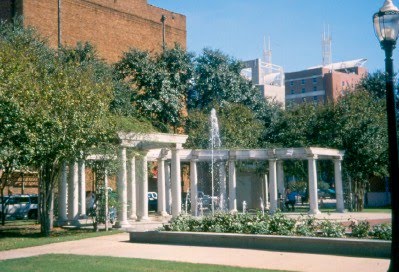
Bienville Square (pictured), is one of several restful corners in the city and the sun was causing the water of the fountains to glitter like a multitude of sequins.
The best thing to do before beginning to discover the joys of Mobile is to do what I did next. Go to the Welcome Center and Historic Museum at Fort Conde.
As well as picking up lots of information about the city, including self-guided walking tours of the historic districts, there is a video about Mobile to watch. Fort Conde itself is a replica of the 18th century French fort and is where costumed guides give free tours.
I love the story about the streets of Mobile. They were originally paved with wood blocks which, when the roads flooded, would float away. That wasn’t the only reason why the wood blocks disappeared – homes in those days had open fireplaces and what more convenient for lighting the fire than wood blocks!
While giving a demonstration of the firing of a musket our guide explained that the saying “flash in the pan” comes from the flash in the pan of the musket as it is fired. He had lots of other bits of information like that.
In the museum are two rooms, one representing a room where the regular soldiers bedded down – very basic - and the other is an Officer’s bedroom. While looking at the Officer’s room some schoolchildren were asked to point out the differences – such as the bed, chest of drawers etc. What was the first thing they noticed? A certain item of pottery ware – the chamber pot.
Leave it to children to provide a laugh!
Not far from Mobile are places such as Bellingrath House and Gardens, the Estuarium (an aquarium) and some beaches.
Labels:
Bellingrath House,
Bienville Square,
Estuarium,
Mobile Alabama
Subscribe to:
Posts (Atom)